
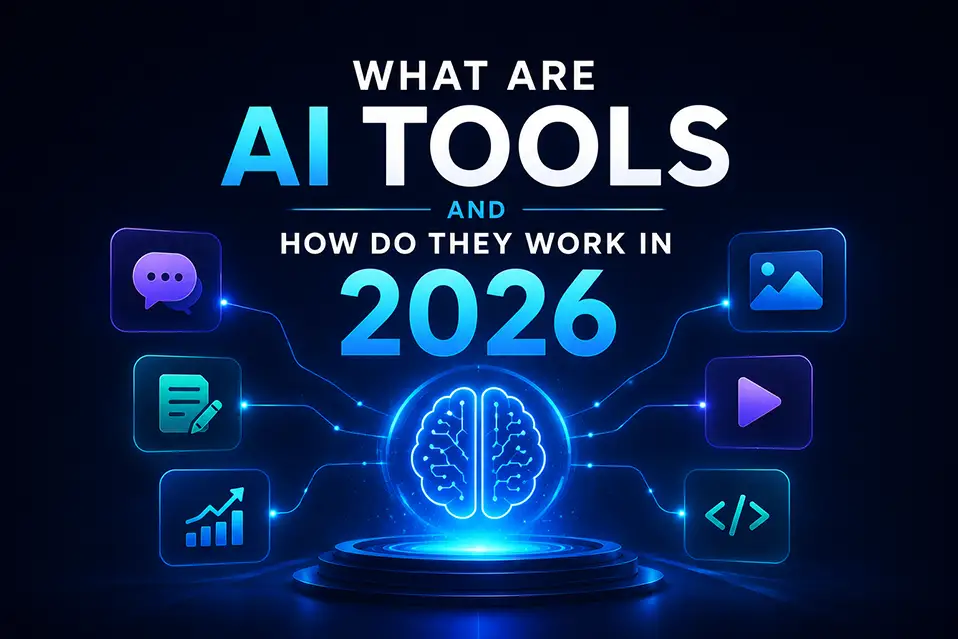
What Are AI Tools and How Do They Work in 2026
Share


AI tools are software platforms powered by artificial intelligence that help people complete tasks faster, automate repetitive work, improve decision-making, and generate new content. In 2026, AI tools are being used across nearly every industry, from marketing and customer service to coding, analytics, research, operations, and content creation.
The rapid growth of generative ai has changed how businesses and individuals interact with software. Instead of relying only on traditional menus and manual processes, users can now interact with systems using natural language prompts. Modern platforms can write articles, generate images, analyze data, summarize meetings, build workflows, answer questions, and assist with automation inside daily business operations.
What makes today’s ai tool ecosystem different from older software is the ability to learn patterns, respond conversationally, and create new outputs rather than simply organizing existing information. Many of the best ai tools now function as intelligent assistant systems capable of handling tasks that previously required teams of people or specialized software.
For businesses, this shift is not just about productivity. AI is increasingly becoming part of how companies scale operations, improve efficiency, support employees, manage customer interactions, and streamline business processes. For consumers, AI products are becoming integrated into search, writing, design, education, shopping, and personal organization.
This guide explains what AI tools are, how they work, the different types of ai systems available today, and where they fit into modern workflows and business strategy.
Most modern AI platforms are built on large ai model systems trained using enormous amounts of data. These machine learning models identify relationships and patterns across text, images, audio, code, and user interactions. Once trained, the systems can generate responses, analyze information, or complete tasks based on user instructions.
Many AI tools rely on natural language interfaces. Instead of manually configuring software, users type a prompt describing what they want the system to do. The platform interprets the request and produces a result. This may include writing content, performing data analysis, generating code, creating visuals, or automating a workflow.
Systems like ChatGPT and Claude helped popularize conversational AI by making advanced models accessible to everyday users. These platforms can answer questions, create content, summarize information, assist with coding, and help automate research tasks.
Behind the scenes, many tools combine several technologies together, including machine learning models, predictive systems, retrieval systems, image generation engines, automation layers, and search infrastructure. Some systems specialize in a single use case, while others function as broad productivity tools that connect across multiple business functions.
As adoption grows, businesses are increasingly looking beyond basic chat interfaces and integrating AI directly into operations, CRMs, analytics systems, support workflows, and collaboration software.
The popularity of AI is being driven by speed, accessibility, and measurable productivity gains. Many businesses now use ai systems to automate repetitive work that once consumed large amounts of time and labor.
Instead of manually drafting documents, editing images, organizing notes, researching topics, or managing support requests, users can now rely on AI to help complete those tasks in minutes. The ability to automate workflows and reduce manual overhead is one reason AI adoption accelerated so rapidly over the past few years.
Another major factor is accessibility. Many modern platforms offer a free version, free plan, or free trial, allowing users to experiment before committing to enterprise subscriptions. This lowered the barrier to entry for individuals, freelancers, startups, and small businesses.
The rise of generative ai tools also changed expectations around software usability. Rather than requiring technical expertise, users can now interact conversationally with systems and receive human-like ai responses. This made AI significantly more approachable for non-technical users.
Businesses are also realizing that AI is not limited to one department. Marketing teams use AI for content creation and campaign development. Developers use AI for code generation and debugging. Operations teams use automation tools to improve workflows. Customer support departments deploy ai chatbots and virtual assistant systems to handle inquiries more efficiently.
As the latest ai platforms continue evolving, companies increasingly view AI as part of their long-term operational infrastructure rather than simply an experimental technology.
The AI landscape now includes thousands of platforms, but most tools fall into several major categories based on their primary use case.
AI writing tools focus on content generation, editing, research, and communication. These systems help users create blog posts, emails, reports, product descriptions, social media content, and marketing materials. Businesses frequently use ai writing systems to accelerate publishing workflows while maintaining consistency across campaigns.
AI image generation platforms focus on visuals, branding, and creative production. These systems allow users to generate images from text instructions, edit photographs, create advertising assets, and produce illustrations or presentations. Platforms such as Canva, Adobe Firefly, and other ai image systems are increasingly integrated into design and marketing teams.
AI video generators are another rapidly growing category. Video ai platforms can create explainer videos, digital presenters, social content, and even cinematic clips from prompts. Tools like sora and other ai video generation systems represent a major shift in how businesses approach media production.
Development-focused AI platforms assist with coding, debugging, software architecture, and testing. Many developers now use AI daily to accelerate engineering tasks, improve documentation, and reduce repetitive programming work.
Automation tools connect systems together and help businesses automate repetitive operational tasks. These automation tools are especially valuable for organizations managing large amounts of customer data, support workflows, reporting, and internal coordination.
AI search and research tools are also changing how users retrieve information online. Instead of relying entirely on traditional search engines, users increasingly interact with conversational ai search systems capable of synthesizing and summarizing information directly.
Some of the most widely used AI platforms today include tools like ChatGPT, Claude, Gemini, Canva AI, GitHub Copilot, and Midjourney. While many people refer to all of these simply as “AI tools,” they serve very different purposes depending on the use case.
For example, ChatGPT and Claude are often used for research, writing, summarization, coding, and conversational assistance. Platforms like Canva AI and Midjourney focus more heavily on ai image generation and creative design workflows. GitHub Copilot is designed primarily for software development and code generation, while Gemini is increasingly integrated into Google Workspace, search, productivity, and business collaboration tools.
As AI adoption grows, many businesses now use multiple platforms together across different departments. Marketing teams may rely on ai writing and content creation systems, while operations teams use automation platforms and analytics tools to improve workflows and reporting. This broader ecosystem is one reason the AI software market continues expanding so quickly.
Generative ai refers to systems capable of creating entirely new content rather than simply analyzing existing information. These systems can produce text, images, code, video, audio, and other forms of media based on user instructions.
The growth of generative systems fundamentally changed the AI market because the technology moved beyond prediction and into creation. Earlier systems were primarily analytical. Modern generative platforms can now create content that feels conversational, visual, and interactive.
This technology powers many of the most widely used AI applications today, including writing assistants, image generation systems, ai avatar platforms, ai voices, and multimedia generation tools.
Generative AI also plays a major role in business productivity. Teams now use AI to create content, summarize research, draft communications, generate reports, and support internal operations at scale.
Many of the latest ai models are also multimodal, meaning they can understand and process both text and media together. This allows users to upload screenshots, documents, images, spreadsheets, or videos and receive contextual outputs that combine multiple forms of understanding.
As tools in 2026 continue evolving, multimodal generative systems are expected to become standard across most major enterprise software platforms.
One of the most important shifts happening in AI is the evolution from simple assistant systems toward more autonomous ai agent platforms.
An AI assistant typically helps users complete tasks interactively. The user gives instructions, asks questions, or provides prompts, and the system responds. Platforms like ChatGPT function primarily this way, helping users research, write, organize ideas, and complete work more efficiently.
An AI agent, however, is designed to perform more independent multi-step actions. Rather than simply answering a question, the system can plan tasks, retrieve information, interact with applications, and complete processes with less human oversight.
For example, an AI agent may:
Some organizations are already deploying multiple ai agents together inside larger operational environments.
This distinction is becoming increasingly important because many businesses are shifting from experimental AI adoption toward operational AI integration. Instead of simply using AI to help employees work faster, companies are exploring how to build systems that actively participate in daily operations.
Businesses are using AI across nearly every department, and adoption is no longer limited to technology companies.
Marketing teams use ai marketing tool platforms to support SEO, advertising, audience targeting, campaign development, and ai content production. AI can help generate headlines, organize keyword research, create landing pages, and improve marketing campaigns through faster iteration and testing.
Customer support departments increasingly deploy ai chatbots and conversational systems to improve response times and reduce ticket volume. These systems can answer common questions, retrieve account information, and escalate issues when needed.
Operations teams use automation and analytics platforms to improve reporting, streamline internal communication, and reduce repetitive administrative work. AI meeting systems now help transcribe conversations, summarize action items, and organize collaboration workflows.
Development teams continue integrating AI into engineering environments to accelerate coding, improve documentation, assist with testing, and support software architecture decisions.
Even smaller businesses are beginning to use AI to help improve efficiency because many free ai and low-cost platforms make advanced technology accessible without enterprise budgets.
As AI adoption matures, companies increasingly focus on measurable operational outcomes rather than simply experimenting with popular ai tools.
Not every platform delivers the same quality, reliability, or long-term value. Businesses evaluating AI software should focus on practical operational fit rather than simply chasing the latest ai trends.
The best AI tools are usually the ones that integrate naturally into existing workflows while solving real operational problems. Ease of use matters because employees are far more likely to adopt systems that reduce friction rather than increase complexity.
Security and compliance are also becoming major considerations, especially for organizations handling sensitive customer information or internal business data.
Scalability is another important factor. Some free tools work well for individual users but become limited as organizations grow. Enterprise teams often require collaboration features, integrations, governance controls, advanced automation, and broader analytics capabilities.
Businesses should also consider whether a platform supports their primary use case. Some systems are optimized for writing, others for design, coding, automation, ai search, or productivity management.
The AI market is evolving rapidly, which is why many companies are testing several platforms before deciding which systems fit best within their operational environment.
Despite rapid improvement, AI systems still have limitations. AI outputs can sometimes contain inaccuracies, outdated information, or fabricated details. Human review remains important, especially in industries involving legal, medical, financial, or regulatory information.
Businesses also need to understand that AI systems vary significantly in quality. Results can depend heavily on the quality of the prompt, the underlying ai model, and the type of task being performed.
Another challenge involves overreliance on automation. While AI can improve efficiency, companies still need human oversight, strategic thinking, creativity, and decision-making.
Privacy and security concerns are also becoming more important as businesses integrate AI into internal systems and customer workflows.
For these reasons, many organizations approach AI as a support layer designed to enhance human work rather than completely replace it.
AI tools for 2026 are becoming more integrated, more multimodal, and more operationally focused than earlier generations of software.
The market is shifting toward platforms that combine search, automation, content generation, analytics, and assistant capabilities into unified systems. Businesses increasingly want AI to function as part of broader operational infrastructure rather than isolated applications.
We are also seeing rapid growth in autonomous workflows, AI agents, and systems capable of handling increasingly complex tasks with minimal supervision.
Meanwhile, competition between platforms like ChatGPT, Claude, Google ai systems, and emerging enterprise platforms continues accelerating innovation across the industry.
As adoption expands, AI is becoming less about novelty and more about operational advantage. Companies that successfully integrate AI into daily workflows are increasingly positioned to improve speed, scalability, customer experience, and efficiency.
For individuals, AI is becoming part of everyday digital interaction. From ai app experiences and assistant platforms to search, design, research, and communication, the role of AI in daily work will likely continue expanding across nearly every industry category.
As AI continues evolving, businesses and consumers are increasingly moving beyond experimenting with AI and beginning to integrate it into daily workflows and long-term operational strategy. The companies seeing the strongest results are typically the ones using AI to improve efficiency, automate repetitive tasks, support employees, and streamline decision-making rather than treating it simply as a trend or standalone tool.
AI tools are software systems powered by artificial intelligence that help users automate tasks, generate content, improve workflows, and increase productivity.
Generative AI platforms can create text, images, code, video, and other media based on natural language prompts.
Businesses now use AI across marketing, customer support, operations, coding, analytics, and content workflows.
AI assistants and AI agents represent different levels of automation and operational capability.
Modern AI systems increasingly combine automation, search, content generation, and analytics into unified platforms.
Many businesses are integrating AI into long-term operational strategy rather than treating it as experimental technology.
The future of AI will likely center around multimodal systems, autonomous workflows, and deeper integration into business infrastructure.
Traditional software follows fixed rules and manual workflows, while AI tools use machine learning and natural language systems to analyze information, generate outputs, and adapt responses based on user input.
Generative AI tools are systems capable of creating new content such as text, images, video, audio, or code from prompts or uploaded information.
Some of the most widely used platforms include ChatGPT, Claude, Gemini, Canva AI, GitHub Copilot, and AI automation platforms designed for workflow management and productivity.
Many AI platforms offer free plans or limited free usage, although advanced features, larger usage limits, and business integrations often require paid subscriptions.
Businesses use AI for content creation, automation, customer support, analytics, coding, research, SEO, operations, and workflow management.
Most companies currently use AI to support employees and improve efficiency rather than fully replace human teams. Human oversight, creativity, and decision-making are still critical in many industries.
 Leader Spotlight
Creating personalized wedding experiences that feel effortless, authentic, and unforgettable.
Read more Blog
Blog
AI writing tools now go beyond basic content generation, supporting SEO, content creation, research, and business workflows for scalable digital...
Read more Top Lists
AI tools are now essential for writing, research, coding, design, and automation. The real challenge is choosing the right tool...
Read more